Zero Based Budgeting vs Incremental Budgeting
You open your budget after payday, copy last month's figures into a new sheet, adjust a few amounts, and move on. Nothing looks obviously wrong, yet the same unused subscriptions, padded categories, and unexplained spending keep returning. The spreadsheet is recording decisions, not improving them.
That's the core issue behind zero-based budgeting vs incremental budgeting. The method you use to build the budget determines whether you challenge old assumptions, protect stability, or waste staff time rebuilding figures that never needed a full review. Zero-based budgeting starts fresh and assigns every dollar a purpose. Incremental budgeting starts with the previous period and adjusts it.
The best answer usually isn't ideological. It's a practical choice between pure zero-based budgeting, pure incremental budgeting, and a hybrid model that uses each method where it creates the most value.
Why the Way You Build a Budget Matters
A budget can look precise while hiding weak decisions. If you carry forward last month's spending, you're assuming that every category still deserves the same treatment. That may be reasonable for rent or payroll. It's much harder to defend for software, travel, advertising, entertainment, or any cost that grew because nobody questioned it.
Budget construction controls attention. Incremental budgeting preserves continuity by using the prior period as its starting point. Zero-based budgeting forces a fresh justification for every line. The first method is faster. The second is more demanding, but it gives you a better chance of finding spending that survived only because it was already there.
A useful budget should answer three questions:
What are we funding? Each category should connect to a household priority, operating requirement, or business objective.
What changed? Income, prices, staffing, customer demand, and obligations can all alter the right allocation.
What should stop? A budget that never removes anything is only a spending forecast.
For households, the same principle applies. A budget isn't just a list of bills. It's a decision about what happens to income before someone else, or an impulse purchase, claims it. If you're building a business plan, budgets for business offers useful context on turning financial figures into operating decisions.
Zero-based budgeting gives every dollar a fresh job during each planning cycle. Incremental budgeting gives last period's plan a controlled adjustment and asks decision-makers to focus mainly on the difference. Neither is automatically superior. The right choice depends on how volatile your finances are, how much scrutiny you need, and how much administrative work your team can absorb.
What Zero-Based and Incremental Budgeting Actually Mean
Zero-based budgeting, or ZBB, begins at zero. You don't assume that last period's spending deserves renewal. Every department, activity, and expense must be reconsidered, usually against minimum service requirements and the current level of service. The method emerged in the public sector in the 1960s, Texas Instruments adopted it in 1969, and it gained wider attention in the 1970s when Jimmy Carter introduced it in Georgia, as described by ACCA's comparison of budgeting techniques.
For personal budgeting, the operating rule is simple: expected income minus assigned spending, saving, and debt payments must equal zero. A freelancer expecting $6,200 in monthly income could assign money to tax reserves, rent, software, savings, debt repayment, groceries, transport, and discretionary spending. The point isn't that every category must receive money. The point is that every dollar must have a deliberate destination.
Incremental budgeting takes the opposite route. It carries forward the prior budget and adjusts for known factors such as new legislation, service changes, additional resources, price inflation, and wage inflation, a process outlined in a Northern Ireland Assembly briefing on budgeting. You review what changed, not every assumption from scratch.
One income, two mechanics
The following example uses the same expected income and illustrates the difference in process. The allocations are illustrative, not prescribed targets.
Line Item | Zero-Based Allocation | Incremental Allocation |
|---|---|---|
Expected income | $6,200 | $6,200 |
Tax reserve | Assigned afresh based on current obligations | Carried forward and adjusted if income changes |
Rent | Reapproved as a required housing cost | Prior amount rolled forward |
Software | Each subscription reviewed for current use | Prior software total retained unless a change is noticed |
Savings | Assigned as a current priority | Prior savings allocation adjusted if needed |
Discretionary spending | Receives only the amount intentionally assigned | Prior category usually continues with a modest adjustment |
New subscription | Must displace another allocation or use unassigned income | Added as an incremental increase or absorbed elsewhere |
A $50 raise creates different decisions. Under ZBB, you decide where the new money belongs before spending it. Under incremental budgeting, you may leave the existing structure intact and adjust one or two categories. A new subscription receives the same scrutiny under ZBB as any other line, while incremental budgeting may allow it to slip into the plan as a small addition.
For a company, the same distinction shapes planning discipline and reporting workload. Resources such as company financial planning with Nexist can help connect budgets with broader planning, but the underlying choice remains the same. You either reapprove the full spending structure or refine the previous one. A practical zero-based budgeting example can make the personal version easier to set up.
Head-to-Head Comparison of the Two Methods
ZBB wins when the central problem is uncontrolled or inherited spending. Incremental budgeting wins when the central problem is speed, consistency, and limited administrative capacity. Treating one as universally better is bad financial advice.
The comparison below focuses on the criteria that affect day-to-day use.
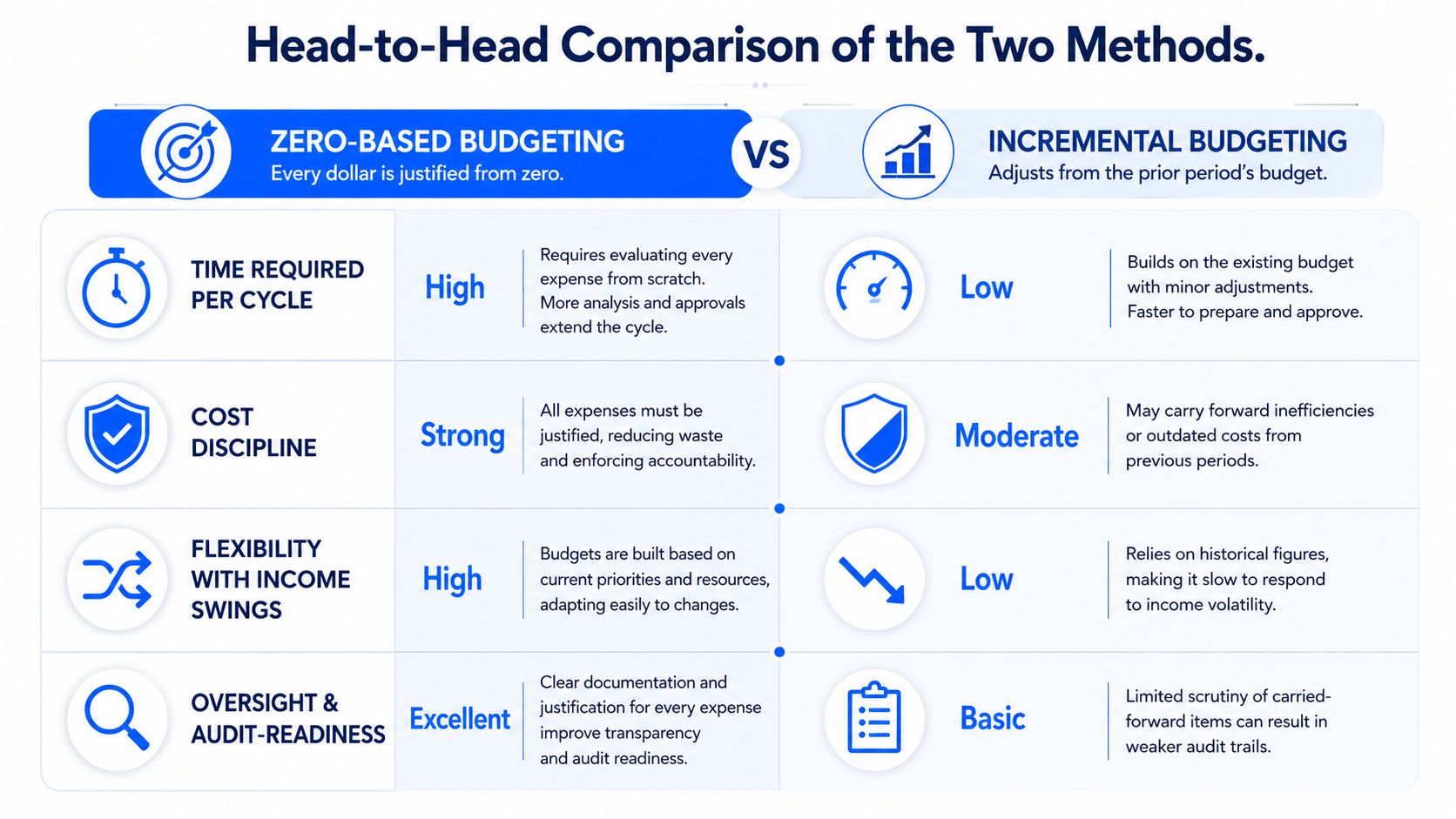
Decision criterion | Zero-based budgeting | Incremental budgeting |
|---|---|---|
Time required per cycle | High, because every line needs review | Low, because the prior plan is the starting point |
Cost discipline | Strong, especially for discretionary costs | Moderate, with greater dependence on historical baselines |
Flexibility with income swings | High, because allocations can be rebuilt | Lower, because the existing structure tends to persist |
Oversight and audit-readiness | Excellent when justifications are documented | Basic unless separate review controls are added |
Staff and admin burden | Materially higher | Relatively light |
Growth-phase fit | Useful during restructuring or cost resets | Useful during stable operations and recurring closes |
Where ZBB earns its keep
ZBB makes managers explain what an expense does, who benefits, and whether the activity still deserves funding. That can expose duplicated software, underused services, low-value campaigns, and categories that exist because they existed last period. Its design aims to direct resources toward the highest-need activities, but the review burden is substantially higher because all expenditure lines require justification, as noted in this comparative budgeting analysis.
The downside is human as much as administrative. If employees must rebuild every line every month, they can spend more time defending small expenses than managing performance. ZBB also becomes demoralizing when leaders demand justification but make decisions based on politics rather than evidence.
Where incremental budgeting works better
Incremental budgeting is fast and predictable. A stable company can update recurring costs, approve the plan, and spend its energy on operations instead of reconstructing known commitments. It also makes recurring monthly closes easier for finance teams managing multiple departments or clients.
Its weakness is the zombie line item, a cost that keeps receiving funding because nobody owns the decision to remove it. Incremental budgeting doesn't create waste by itself. It gives waste a convenient place to hide.
The hybrid is a real operating model
The most sensible structure for many organizations is hybrid. Keep incremental budgeting for stable categories such as rent, insurance, and payroll baselines. Apply ZBB reviews to variable cost centers such as marketing, software, travel, and discretionary spending during the annual plan or a targeted reset.
Practical rule: If the time spent re-justifying a line exceeds the savings or insight it produces, stop using pure ZBB for that line.
Evidence from academic-library budgeting points in the same direction. Incremental budgeting remained dominant, while ZBB was seen as more inclusive but also limited, and a 2025 university-budget survey reported incremental budgeting at 41%, hybrid models at 39%, with ZBB more common in smaller institutions and two-year colleges, according to the published survey research. The practical message is blunt: organizations usually optimize for governance and staffing capacity, not budgeting purity.
Which Method Fits Which Type of User
Your income pattern and decision workload matter more than the label attached to the budget. Someone with uneven income needs a system that reallocates cash quickly. Someone with stable pay and predictable bills may gain little from rebuilding the same plan every cycle.
User Type | Recommended Method | Why It Works | Watch Out For |
|---|---|---|---|
Individual with irregular income | Zero-based | It assigns available cash deliberately and exposes overspending early | Don't treat every tiny purchase as a planning crisis |
Couple or household with predictable salaries | Incremental | A proven spending split can continue with small adjustments | Review subscriptions and discretionary categories periodically |
Freelancer or solopreneur | Zero-based or hybrid | It connects cash allocation with taxes, savings, business costs, and personal needs | Separate business and personal spending before allocating money |
Small business with stable revenue | Incremental | Recurring costs and monthly reporting remain manageable | Historical budgets can preserve weak cost assumptions |
Growing small business | Hybrid | Stable overhead can roll forward while expansion costs receive fresh scrutiny | Assign clear owners to variable categories |
Accountant serving multiple clients | Incremental for recurring closes, ZBB for annual planning | It protects monthly capacity while reserving deeper analysis for important decisions | Don't use one method blindly across every client |
Freelancers usually benefit from ZBB because cash flow and tax obligations can change quickly. The method forces you to reserve money before treating the balance as spendable income. For households with predictable salaries, incremental budgeting is often the better default because most recurring bills don't need a philosophical debate every month.
Small businesses need a sharper distinction. Stable revenue and familiar cost patterns favor incremental budgeting. Rapid hiring, restructuring, falling margins, or uncertain income favor targeted ZBB reviews. The choice should follow the financial problem, not the trendiest budgeting framework.
Accountants can preserve time by using incremental budgets for routine monthly work and reserving ZBB for annual planning, restructuring, or a department that repeatedly misses expectations. For a practical explanation of tracking planned figures against actual results, use these practical FP&A insights.
Step-by-Step Implementation for Each Approach
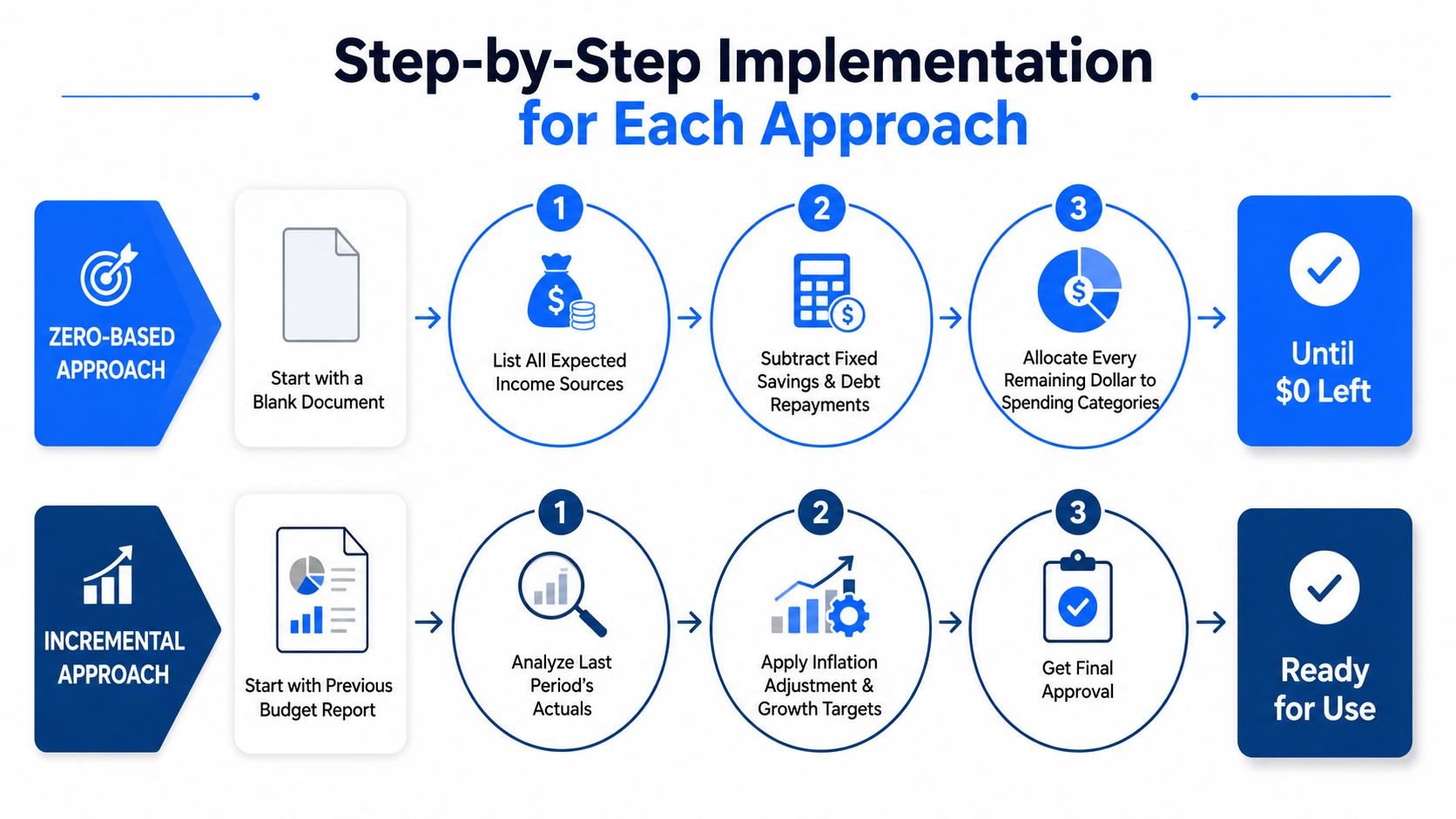
Start with a blank worksheet for ZBB and a prior-period report for incremental budgeting. Don't mix the starting points, because doing so weakens the discipline each method is supposed to provide.
Building a zero-based budget
List expected income. Include only income you reasonably expect to receive during the planning period. For irregular earners, separate confirmed income from uncertain income.
Reserve priorities first. Allocate tax reserves, essential savings, insurance, and debt repayments before discretionary categories.
List operating and living costs. Add rent, payroll, utilities, groceries, transport, software, marketing, travel, and other relevant lines.
Justify every nonessential line. State the purpose, owner, expected benefit, timing, and alternative. Corporate decision packages should sit beside the line item, not in a separate folder nobody opens.
Allocate the remaining balance. Continue assigning money until the unallocated balance reaches zero.
Approve and monitor. Compare actual spending with the approved purpose, not only with the total.
A simple spreadsheet can use columns for , , , , , , and . Bank-statement parsing tools can populate historical categories and averages, which speeds the first draft, but automation shouldn't decide whether an expense deserves renewal. Use this guide to categorizing expenses if your transaction data is still inconsistent.
Building an incremental budget
Import the prior period. Use the previous month, quarter, or year as the base.
Compare actuals with the prior plan. Identify categories where spending differed materially from expectations.
Investigate meaningful variances. Don't waste time explaining a trivial movement while ignoring a structural cost change.
Apply the relevant adjustment. Use a documented inflation, wage, price, revenue, or policy assumption.
Add approved changes. New hires, subscriptions, projects, and contractual obligations should appear as explicit adjustments.
Review and approve the final plan. Keep an audit trail showing the original amount, adjustment, reason, and approver.
A basic Excel or Google Sheets template might use:
Category | Prior Budget | Adjustment | New Budget | Reason |
|---|---|---|---|---|
Rent | Prior amount | Contract change | Lease update | |
Software | Prior amount | Approved addition | New requirement | |
Payroll | Prior amount | Staffing adjustment | Headcount plan |
For a percentage-based adjustment, use where the adjustment cell contains the documented rate. Keep the assumption visible. A formula is not an explanation.
Use the video below as a visual supplement while setting up the process, but keep your own category definitions and approval rules documented.
For most households, a monthly ZBB cycle is manageable because the budget owner is also the spender. Stable businesses usually need a lighter incremental process during the year, with a deeper hybrid review during annual planning.
Transition Checklist, KPIs and Common Pitfalls
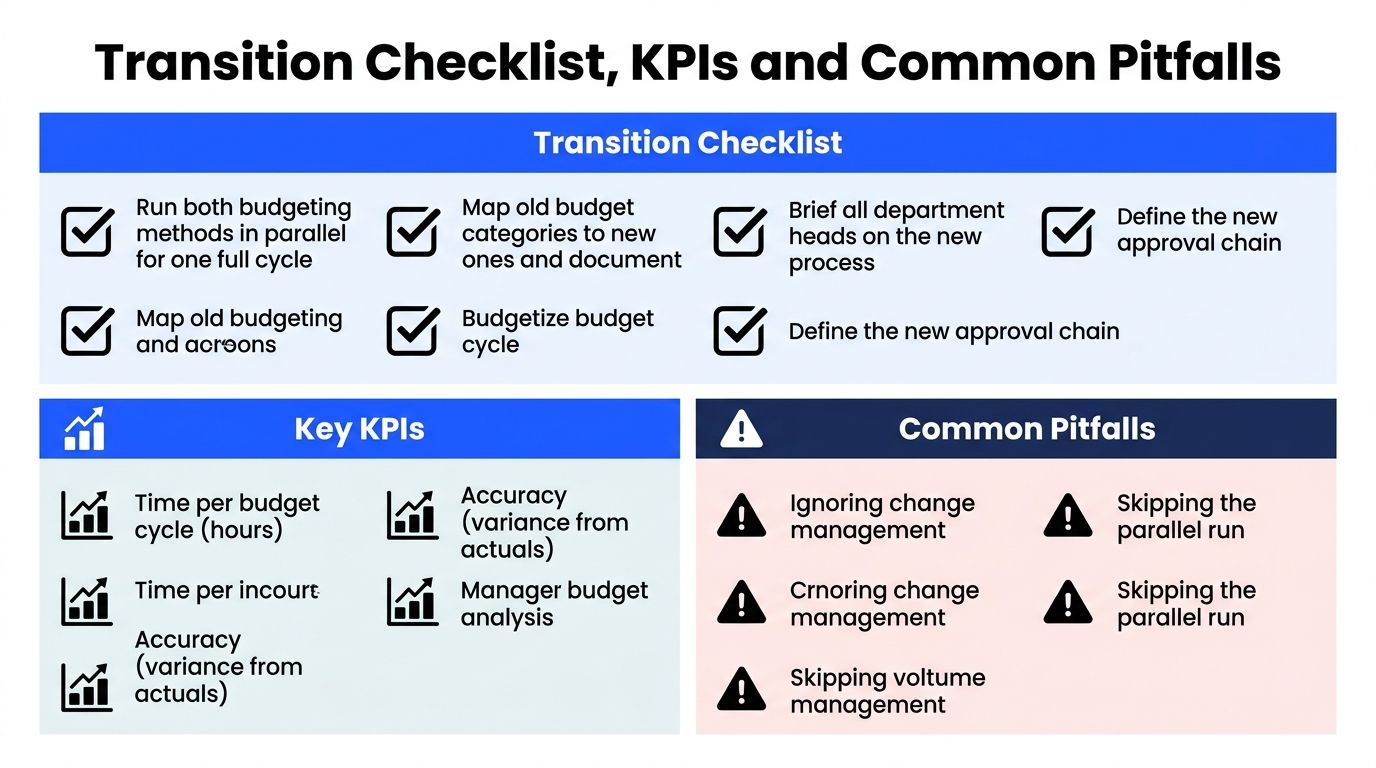
Changing the budgeting method can disrupt reporting if you import old categories without translating them. Run the new process beside the old one for a full cycle, document the category mapping, and tell every budget owner what evidence they now need to provide.
Transition checklist
Run both methods in parallel: Compare outputs before retiring the old process.
Map categories first: Document how historical lines translate into the new structure.
Brief requesters: Explain new deadlines, approval requirements, and justification standards.
Set the cadence: Decide when budgets are prepared, reviewed, revised, and closed.
Name owners: Every material category needs someone accountable for the result.
Preserve the audit trail: Keep assumptions, approvals, changes, and explanations together.
Track variance versus plan under either method. ZBB users should also monitor the share of categories with documented justifications. Incremental users should track rolling forecast accuracy and whether repeated variances trigger a deeper review. Both methods need one uncomfortable KPI: hours spent per budgeting cycle.
The common ZBB mistake is micromanagement. Teams rebuild trivial expenses weekly, debate small movements, and lose sight of strategic costs. Incremental users make the opposite error. They let old lines linger, accept weak explanations, and mistake a stable spreadsheet for a healthy cost structure.
The staffing cost trap
Lean teams often underestimate the labor consumed by ZBB. Literature continues to describe ZBB as more resource-intensive than incremental budgeting because each expense must be justified from zero, while comparative evidence from Nigeria found no significant difference in overall government performance between the methods, even though ZBB differed in cost-reduction techniques, as reported in the comparative study.
A three-person team spending 40 hours a month on a ZBB cycle can create roughly $2,000 in opportunity cost, based on the scenario provided. That figure isn't a universal cost rate. It's a warning to compare the process burden with the savings it produces. Use a clear budget variance reporting guide to make that comparison visible.
Choosing the Right Method or a Smart Hybrid
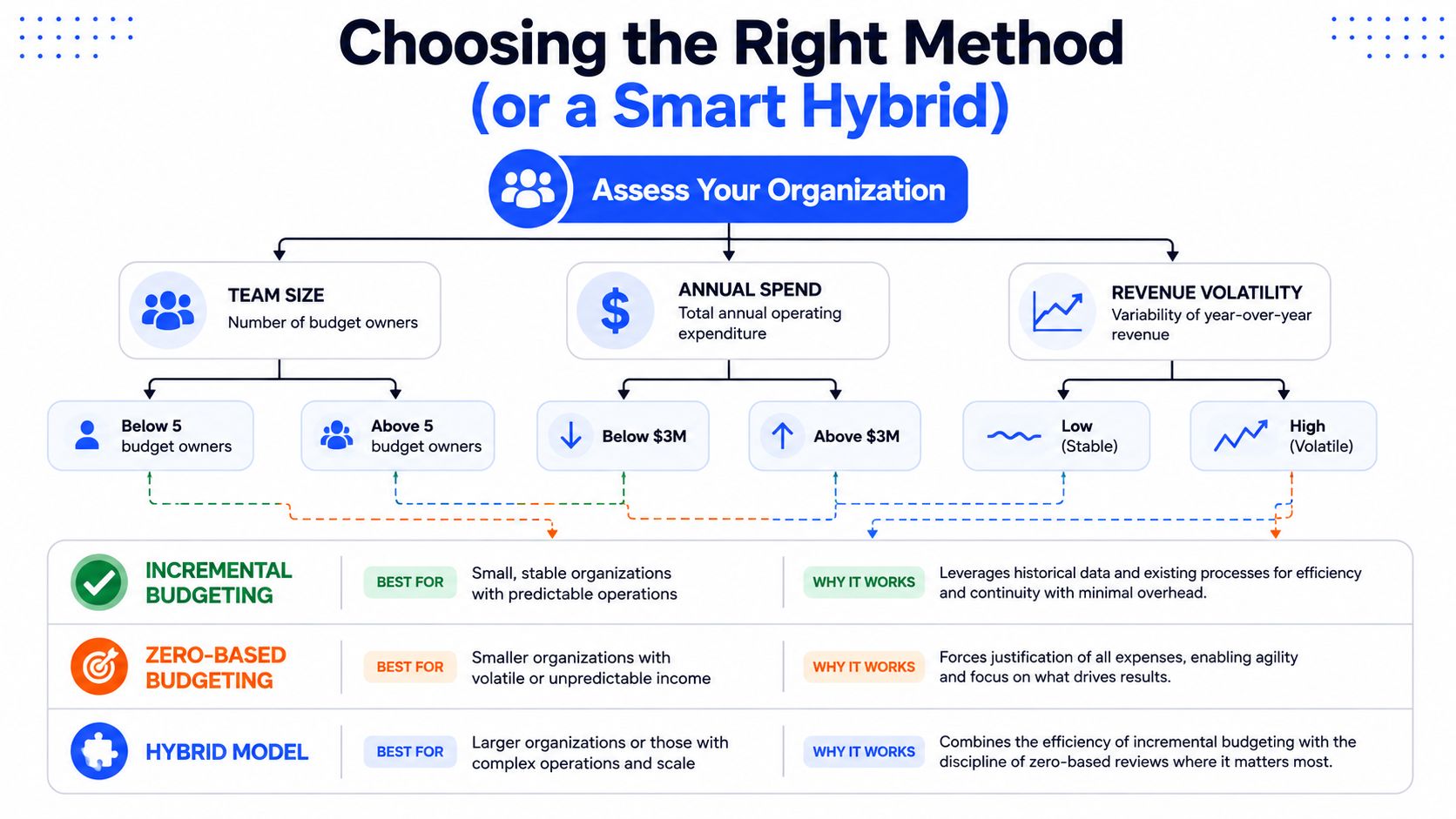
Use incremental budgeting when your team is small, revenue is stable, recurring costs are understood, and the primary need is a fast operating plan. Use zero-based budgeting when income is volatile, waste is the central concern, or leadership has explicitly ordered a cost reset. Don't run pure ZBB by habit. It's a tool for scrutiny, not a badge of financial sophistication.
The practical threshold is about capacity. For organizations below roughly $3 million in annual spend or with fewer than 5 budget owners, pure ZBB often stops paying back the time it consumes, according to the decision framework in the brief. Incremental budgeting is usually the smarter default there, unless volatile income or a major restructuring makes fresh allocation essential. Larger organizations, or teams under a clear cost-discipline mandate, can justify ZBB more readily, but they still shouldn't rebuild every department every cycle.
The hybrid operating model
Run a zero-based review during annual planning, then use incremental adjustments for in-year changes. Reserve a full reset for departments that miss targets by more than 10%, using the threshold as a management trigger rather than a universal accounting rule. Keep stable obligations on the lighter process and direct detailed scrutiny toward spending that is flexible, strategic, or repeatedly off plan.
Ask yourself three questions:
Is the budget owner accountable for the outcome?
Is the variance material enough to justify investigation?
Is the category strategic, discretionary, or structurally changing?
If the answers are mostly no, choose incremental budgeting. If they're mostly yes, use ZBB for that category or department. If the answers vary across the budget, choose hybrid. That decision takes less than a minute and avoids forcing one method onto every line.
If you want to compare budgeting apps and bookkeeping tools before putting this framework into practice, visit Senki. Senki reviews financial tools that can support allocation-first budgeting, expense tracking, investing, and small-business money management, helping you choose software that fits the method your budget can sustain.